You Crossed an Ocean to Study Here. But Do You Know Why You're Really Here?
Every year, over 1 million international students come to the United States to pursue higher education. They come from India, China, Korea, Nigeria, Brazil, Vietnam, and dozens of other countries. They leave behind families, languages, comfort zones, and everything familiar.
They come for opportunity. For a better future. For the American Dream.
But in 2026, that dream looks very different from what the brochure promised.
The Unique Pressure on International Students

International students face pressures that domestic students never think about:
- Visa dependency: Your F-1 visa is tied to your enrollment. Drop out or fail, and you go home. This creates paralyzing fear of taking risks.
- Family sacrifice: Your parents may have spent their life savings — or gone into debt — to send you here. The weight of that sacrifice makes every decision feel monumental.
- Cultural expectations: In many cultures, only certain careers are considered "worthy" — doctor, engineer, lawyer, MBA. Your family didn't sacrifice everything for you to study art history.
- OPT/H-1B pressure: You need a job that sponsors your visa. This eliminates 80% of career options before you even consider what you actually want.
- Language and isolation: Navigating a foreign academic system in a second (or third) language while battling homesickness and cultural adjustment.
The result? International students often choose majors based on visa viability, not personal fit. They optimize for survival, not fulfillment.
AI Makes This Worse
Now add AI to the equation:
- The CS degree you chose because it guaranteed H-1B sponsorship? AI is automating entry-level coding jobs.
- The data analytics program you picked because it was "practical"? AI tools now do the analysis faster and cheaper.
- The MBA you're pursuing for career flexibility? AI is disrupting middle management across every industry.
International students are being squeezed from both sides: visa restrictions limit their choices, and AI is eliminating the "safe" choices that remain.

What Your Parents Didn't Know (And Couldn't)
Your parents gave you the best advice they had. "Study hard. Get a degree. Get a good job." In their generation, this formula worked. A degree from an American university was a golden ticket.
But the world has changed faster than anyone predicted. The formula is broken — not because your parents were wrong, but because the rules changed mid-game.
Here's what they couldn't have known: the most valuable thing you carry isn't your transcript or your visa. It's your DNA — a unique combination of genetic traits shaped by thousands of years of your ancestral lineage.
Your Heritage Is Your Superpower
As an international student, your genetic heritage carries something extraordinary: diversity. Your DNA reflects adaptations, strengths, and traits that evolved in environments vastly different from the American mainstream.
- A student from East Africa might carry genetic variants associated with exceptional endurance and resilience — traits that translate into persistence and long-term thinking in any career.
- A student from East Asia might carry variants linked to high conscientiousness and pattern recognition — invaluable in research, design, and strategic roles.
- A student from South Asia might carry variants associated with linguistic flexibility and social intelligence — crucial for cross-cultural leadership.
- A student from Latin America might carry variants linked to creativity and emotional expressiveness — assets in innovation, communication, and the arts.
These aren't stereotypes. They're genetic tendencies — probabilistic, individual, and real. And they're yours, regardless of what major you chose or what visa category you're in.

High School Exchange Students: The Youngest Ones Asking the Biggest Questions
They're 15, 16, 17 years old. They left their families, their friends, their language — to spend a year in an American high school. They're the bravest teenagers on the planet, and nobody talks about them enough.
High school exchange students (typically on J-1 secondary school programs) face a unique version of the identity crisis:
- They're asked to choose AP classes and college-prep tracks in a foreign education system they barely understand
- They see American students stressing about SATs and college applications — and wonder if they should do the same
- Their host families and schools expect them to "make the most of this opportunity" — but no one tells them how
- They return home after 10 months and are expected to seamlessly reintegrate into their home country's system — as if nothing happened
- But everything happened. They changed. And they can't explain how.
For a 16-year-old exchange student, the question isn't "What should I major in?" — it's even more fundamental: "Who am I, really?" They're straddling two cultures, two languages, two versions of themselves. And they're supposed to figure it all out before they turn 18.
What your DNA says: At 16, you already carry every genetic trait you'll ever have. Your predisposition for creativity, leadership, analytical thinking, empathy — it's all there. You don't need to "find yourself" through trial and error across two continents. Your Gene Type can give you a scientific starting point — a compass that works in any country, any culture, any language.
The exchange year isn't just about learning English or American culture. It can be the year you discover who you were built to be — and carry that knowledge home as the most valuable souvenir of all.
J-1 Exchange Students: A Different Pressure, Same Crisis
J-1 visa holders face a unique variant of this crisis. Unlike F-1 students who can pursue OPT and H-1B pathways, many J-1 exchange students face the two-year home residency requirement — meaning they must return to their home country after their program ends.
This creates an agonizing situation:
- You experience the American academic system, build networks, and develop new skills
- You see career possibilities that don't exist back home
- But your visa requires you to leave — and the skills you gained may not transfer to your home country's job market
- AI is disrupting industries in your home country too, often faster than in the U.S.
For J-1 students, the question is even more urgent: "What can I bring home that will still matter in 5 years?" The answer isn't a specific technical skill (AI will learn it). It's self-knowledge — an understanding of your innate genetic strengths that applies in any country, any market, any era.
Your Gene Type doesn't have a two-year home residency requirement. It goes wherever you go.
Beyond the Visa: Finding Your Real Direction
Here's a radical thought: what if you stopped optimizing for visa sponsorship and started optimizing for genetic alignment?
This doesn't mean being impractical. It means adding a new dimension to your decision-making:
Instead of: "Which major has the highest H-1B approval rate?"
Also ask: "What are my innate genetic strengths, and which careers let me use them?"
Instead of: "What do my parents expect me to study?"
Also ask: "What does my DNA say I was built for — and how do I honor both my heritage and my biology?"
The most successful people — in any country, in any era — are those who found the intersection of what the world needs and what they were born to do. Your Gene Type can help you find that intersection faster than any career counselor or visa lawyer.
A Message to International Students
You didn't cross an ocean to become a slightly different version of everyone else. You came here because you carry something unique. Your DNA — shaped by your ancestors, your homeland, your heritage — is a blueprint that no immigration policy can take away and no AI can replicate. Honor it.
Your Gene Type Doesn't Need a Visa
Whether you stay in the U.S. or return home, whether you get H-1B sponsorship or start your own company, whether you follow your parents' plan or forge your own path — your Gene Type travels with you. It's not tied to a country, a degree, or an employer.
It's tied to you. And it always will be.
You traveled thousands of miles to find your future. Your DNA has been carrying the answer the whole time. Discover your Gene Type — and find the path that honors both where you came from and who you truly are.
Don’t have DNA data yet? Get tested with a trusted service:
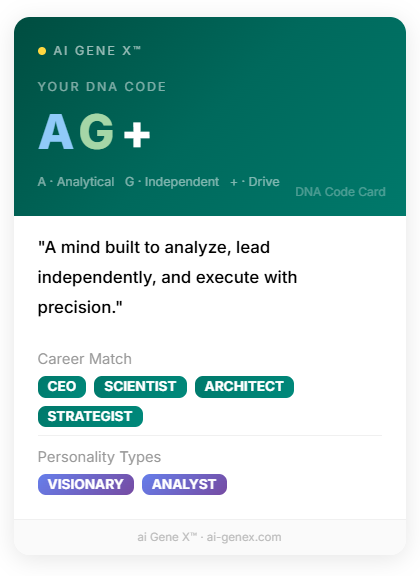
Upload your VCF file to ai-genex.com and discover your DNA Code in 30 seconds.